The Future of Nostalgia
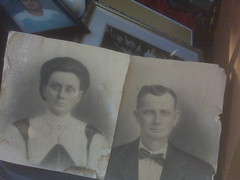
These photos of my paternal great-grandparents were taken to commemorate their wedding.
As we prepared for my maternal grandmother’s funeral, it was my honor to go through a few boxes of her mementos and write a eulogy. She and I always had a special relationship, so it was a melancholy and nostalgic journey that lasted well into the early morning hours. I discovered that she was voted most beautiful in her high school class, and a host of other unknown facts. I even discovered a piece of her 60 year old wedding cake, carefully wrapped in foil.
As we go through life, acquiring stuff, we rarely think about what will happen to our stuff when we die. At a certain age, or when we have children, we may create a Will, but for the most part, we rarely think about those little things that clutter the corners of our desk drawers. It isn’t the photos, valuables, or capital items that we ignore, but the old letters, concert ticket stubs, and not-so cherished knickknacks.
As my grandmother’s health deteriorated, my mother had the unenviable task of downsizing her estate. First she moved from a three-bedroom ranch home (with a very full garage, craft room, kitchen, and attic), to a two-room retirement apartment. As a child of the depression (she graduated from West Linn High School in 1929), she kept everything – margarine tubs and plastic bags were her specialty. The task was quite overwhelming for my Mom and the thought of doing the same is daunting for me!
My Dad didn’t really get rid of anything after my Mom died three years ago. However, several boxes or keepsakes and crafts ended up in my brother’s basement. My Dad isn’t really a sentimental kind of guy. Stuff means very little to him, but when he moved into a new, smaller place, shortly after my Mom’s death, he recreated her decorating style almost perfectly. It was amazing – really! This stuff was important to him, because it had been important to his wife, my Mom, for 49 and a half years.
Temporarily living in a 24-foot travel trailer in our driveway, his stuff was stored in our extra bedroom, garage, and basement. We’ve enjoyed having my Dad “around” and sharing meals with us – but that living arrangement was not for the claustrophobic. Last week he found a small place to rent – and I do mean small. It is a15’x15′ studio house – one room, a tiny bathroom, and a very-small closet.
I asked my brother about the future and what will we do when my Dad dies?

Photo by stuart updegrave - http://www.flickr.com/people/supdegrave/
Even before my brother and I began to unload the trailer, it was very apparent that all of this stuff was not going to fit. Oh, sure, we could get it all in, but there wouldn’t be any living room left over. With the trailer only half unloaded, we were already putting things in the primitive carport. It was obvious that my Dad was going to have to downsize – and we still had another trailer load (or two) at my house. What to do?
On the 15 minute drive to go get more stuff, I asked my brother about the future and what will we do when my Dad dies? In the middle of a move is not the time to decide what to keep and what to throw away – or sell. And my frail, 74 year-old father was already exhausted, stressed, and on his last legs – literally. I’ve never before seen him hunched over his cane like that.
150 years ago, people didn’t have this much stuff! My ancestors lived in one and two-room cabins. My Dad was born in the two-room log cabin his grandfather built, after emigrating across the Oregon Trail. In 1934 when my Dad was born, there was still no electricity, or running water in the house. Most furniture, in the 1800s, was handmade and was easily discarded when it lost it’s usefulness. Family heirlooms usually consisted of a single teacup, or a pocket watch. Photographs and financial portfolios were unheard of. They didn’t face these dilemmas. And given that three generations often lived in one house, what little they had was easily passed on without having to “make it fit.”
All five of my senses seem to be linked to my memories.
In my house, I now have six ten+ large plastic bins full of photographs that span the last 100 years of my paternal and maternal family. I have books, boxes of heirlooms, paintings, favorite pieces of furniture, and boxes of stuff. I, being more nostalgic than my brother, have an emotional attachment to this stuff that makes it hard to discard. But really, what am I going to do with six, mis-matched, antique, China tea-cups? What would I do with a box of hand-embroidered pillow-cases that my maternal great-grandmother gave my Mom on her wedding day? I dont’ have enough storage for my own eclectic collections from a life well-lived.
As I stand in the bedroom where half of my Dad’s stuff is still stored, I see remnants of a life that I want to hold onto. I have cherished my parents, my grandparents, and the stories of my ancestry. I revel in being a fifth-generation Oregonian and the physical mementos let me touch the past. It is a very real form of time travel for me.

Photo by Gary (gazzat) - http://www.flickr.com/people/gazzat/
All five of my senses seem to be linked to my memories. Whether it be a song from my past, a fragrance, or some tactile reminder, it is easy for me to travel back in time. A taste of a comfort-food, or an old photograph, and my mind can leap into my childhood. It is a gift, and a curse.
But the question remains, for how many generations can we continue to collect these analog reminders to our past? My solution (when I get around to it!), take photographs and store the memories digitally.
How do you handle the accumulation of family heirlooms, mementos, and stuff? How will you deal with the disposal of those items, when the time comes? When you look into the past, what do you see? How will you let that explain your future?
CPR Doesn’t Work on Dead People

Photo by: Michael Ferrari - http://www.flickr.com/people/bunshee/
Time stood still as I stood motionless in the stranger’s apartment. It was beautifully furnished. There was a baby grand piano across the room with a silver tea set carefully placed on an expensive table cloth. Exquisite furniture, expensive carpets, and decoration only found in the most expensive homes. Yet, here on the floor, lay an elderly woman in her night clothes. She looked very peaceful.
I was a young, eager, and very inexperienced EMT. Not yet a paramedic, that would come several years into the future. Now, on this quiet Sunday morning in SW Portland, I stood in a luxury, retirement, high rise building in the 16th floor suite of a very unconscious, peaceful elderly woman. My senses sought desperately to keep up with the scene unfolding around me, but my body remained motionless.
My partner on the ambulance that day was one of the first paramedics in the country, yet he was only a few years older than me. His certification number was three – as in the third in the nation. Bob carried himself with the nonchalance of the streetwise, the coolness of the experienced, and the cynicism of someone who has seen the darkest of the human soul. I wasn’t his regular partner, in fact, I normally worked transporting people in wheelchairs. This was just a fill-in shift – to prepare me for my future as a street medic.
As I knelt down next to this very serene lady, I realized there was no one else in the apartment. Who called us? Who let us in? Why was she lying on the floor? I was still dazed and sleepy from being awoken from a sound sleep. The whole experience was so surreal. Driving South on Broadway, through downtown Portland, at 6:00am on a Sunday morning, with red lights flashing against empty storefronts – but in absolute stillness and quiet. And now, standing in this wealthy woman’s home – my mind couldn’t keep up.
“Maybe we should do some chest compressions?” Bob calmly asked as he prepared to assess her EKG with the LifePak heart monitor.
I was jolted into an embarrassed reality. I had taken my first CPR class when I was 15 years old. I’d run my first emergency call that same year. I’d run dozens of calls on a volunteer ambulance in rural, eastern Washington – and yet, here I sat, trying to understand, but without understanding. This woman had no pulse. How did I miss that? In my inexperienced hesitancy, I was taking my clues from my partner.
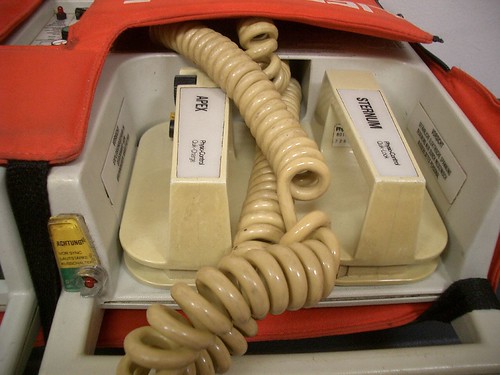
Photo by K. Anders - http://www.flickr.com/people/status6/
I placed my hands on her sternum. I had never performed CPR on a real person before. Her skin was loose, and cold. Her chest was so much more compliant than the CPR mannequins. As I pushed down, her abdomen rose up. With each compression, her stomach would bounce up. One-1000, two-1000, three-1000 – Bob dismissed my meager attempts as he checked her rhythm with the paddles. Asystole – no electrical activity. She was clearly DOA. He began putting equipment back in the kits.
I don’t remember much after that moment. It was a transcendent experience. I had touched death, yet here I was alive to ponder it. I know we didn’t transport her to the hospital, that would be the work of the funeral home. I know we didn’t linger at the apartment, it was time for shift change. I’m not sure who stayed with the body until the funeral home arrived.
But I do remember the piano and the tea set – and how worthless all that stuff was to the serene lady on the floor.
Mercy, Compassion, Empathy, and Self-Differentiation

Photo by Stefano Corso, http://www.flickr.com/people/pensiero/
While getting my haircut last week in Denver, I ended up in this store-wide discussion with the three stylists on duty. It was pretty funny actually, mainly ‘cuz I’m not the kind of guy to be that gregarious. Oh sure, about 20 years ago, as a raging drunk, I can remember dominating the conversation in a crowded bar, but not recently do I remember being this animated and talkative.
These three women kept trying to talk me into a complimentary MVP treatment. Shampoo, head massage, hot towel wrap, and haircut. Unfortunately I only had time for the haircut. At one point, one of the ladies said, “We’re just trying to guilt you into it.”
And I laughed. “I’ve been guilted and manipulated by some of the best,” I replied.
Another of the stylists said she was going to intimidate me into taking the complimentary package.
“Ha!” I said, “Unless you’re over six-foot-two and 200 pounds, it’s going to be difficult to intimidate me into anything!”
One of the ladies, well over 200 pounds, but well short of six-two, said she had me beat if she stood on a stool. Again I laughed. “Unless you’ve worked the streets for 20 years (like I did as a paramedic), it’s still going to be difficult to intimidate me!” We all laughed.
My mother-in-law remains amazed that I could work as a life coach, yet not have compassion and mercy. We’ve had this ongoing discussion for years. She just doesn’t understand how I can be so disinterested in the cares of others, yet do the job I’ve been called to do. I’ve always just shrugged – I don’t know either.
It’s true though, I’ve been manipulated and intimidated by some of the best. I’ve had guns pointed at me, had my life threatened, and some have even attempted suicide to get me to acquiesce. Sometimes I’ve bent, but as I’ve gotten older and wiser, I tend to just walk away. In fact, I just lost my job because I failed to be intimidated away from the values I know in my heart to be right.
While processing the events of the recent past; conversations with the hair stylists, a relative, and others, I suddenly came to a realization. I am compassionate and I do have mercy – but not with everyone. In fact, when I pre-warn people that I don’t have compassion and mercy, what I’m really saying is that they shouldn’t expect it from me. Expectations just lead to pre-meditated resentments.
I believe I am well differentiated. I hadn’t really thought of this until I began reading the book, Failure of Nerve. The author really opened my eyes to this personality/temperament trait. It is this trait that makes people think I don’t have compassion and mercy, but it doesn’t mean I don’t. I just don’t offer it to everyone, blindly.
I don’t suffer fools, enablers, prideful and arrogant people, and manipulators. If someone falls, I’m willing to offer assistance. I have a natural empathy to those caught in situations outside of their control. However, if they continue to repeat behaviors that lead to the same failures, I will show tough love – not enabling. If people are proud and arrogant and refuse to recognize their mistakes or character flaws, well, there isn’t much my compassion will do for them. People who are constantly enabling users and abusers, yet complain about others using and abusing them, well, they need a dose of reality. And those who try to control life through physical, emotional, financial, or even spiritual manipulation – well, I rarely give them the time of day.
Yes, I do have empathy, compassion, and mercy – but not for fools, enablers, manipulators, or the prideful. This was a great revelation for me. Not only do I understand why others get angry at me – they expect me to offer mercy and compassion to everyone, even when it is harmful. In addition, those who are craving attention and tears for the lack of fairness in their lives, often are unwilling to make the changes necessary for their own happiness and survival.
If anything, this was an unexpected benefit of becoming an alcoholic and going through the 12 Steps. I learned to be self-differentiated. I love all unconditionally, but sometimes that love causes me to be tough. I love enough to not enable you to continue to harm yourself, others, or me.
Photo by Tina Vance, http://www.flickr.com/people/tina/
What about you? Is your love for others strong enough to withstand others attempts to manipulate you? How do you treat the fools you encounter? What about the less differentiated in your life, how do you react towards them? Are you an enabler? Do you enable enablers? Do you enable manipulators, abusers, and users? What about those who are too proud to realize their own mistakes? Can you love these folks, but still be true to yourself?
How far would you be willing to go in order to be true to your values? Do you see any value in thinking this through ahead of time? Are you healthy enough to stand up to your children, grandchildren, clients, staff, supervisors, in-laws, parents, etc?
Some people are addicted to their depression and problems. Some are so comfortable in their issues and the drama that surrounds them, they have no desire to change. Others are so addicted to solving others’ problems that they have no desire to stand firm. This is called co-dependency. Are you willing to break the cycle of codependency and broken relationships? How far are you willing to take this?


 Confessing my Dad Attitude