Trivial Pursuits
The longer I’m a dad, and the more I see a lack of responsible fathering in this culture, I am impressed by the trivial pursuits of so many. Never has so little been accomplished by so many.
Last week I had a conversation with a friend regarding her ex-husband and the wake he left behind for their eight year old daughter. It made me think of another eight year old girl that was in my life 20 years ago. I wasn’t her father (I came along after that had happened), but I had stepped into her life more than her biological father ever had. Her mother and I had a tempestuous relationship that only lasted a few years. The last time I saw her daughter, she was eight years old and I was taking care of her in the back of a Life Flight helicopter. I wonder what became of her?
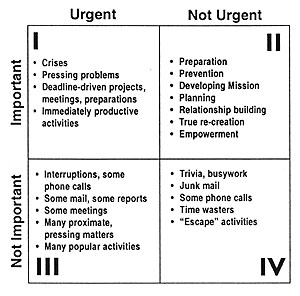 Now that I am the father, and Daddy, to a three year old, I am completely committed, to avoid trivial pursuits. But my commitments are almost worthless sometimes. My addictions and weaknesses seem far stronger. How am I going to avoid the urgent and trivial matters in favor of the non-urgent, but very important matters?
Today, we near the end of our week visiting family in the Midwest. The whole family acquired colds on the flight out here and we are spent. We are looking forward to getting home. My three year-old daughter in particular is done. Several times today she had meltdowns. A couple of them were typical, but a couple of them were just cries of an exhausted little girl.
After one particular meltdown, I laid her on a bed for a brief time out. She quickly fell asleep: for the next three hours! Another time, I was ready to discipline her for her tantrum; as I picked her up to carry her into the other room, she snuggled down in my arms and quickly got calm. This need for her to be held was amplified later when she was eating a snack. She called me over and wanted me to be close. When gramme tried to answer the call, she literally chased her off and summoned me. She just wanted her Daddy close by and I was happy to abide by her request. For what it’s worth, she’s the only daughter I have – and the only first-born child I’ll ever have.
There is a dearth of male leadership in America’s families. Fathers have abdicated their role as the spiritual/moral leaders and physical protectors of their families. Too many fathers would rather spend several hours watching a sporting event on TV then spend several hours with their kids. Too many fathers have settled into a lull of mediocre coasting and are failing to infuse energy, life, and vision into their families. Too many fathers fail to support their wives, their kids’ Mommies, so that they are empowered to support the kids.
We, as fathers, are pursuing trivial matters. The lives and souls of our children are at stake.
Why should we wonder when our children reject us, reject our values, and reject our direction? What we are doing isn’t working; why wouldn’t they reject our pattern? When our kids become addicts, single moms, drop outs, and outcasts, we have nowhere else to point a finger than at ourselves. Now, this isn’t to say that even good parenting can produce children who make bad choices, but wouldn’t we want to provide the best opportunities for our kids to succeed?
It is time for me to quit pursuing the trivial and start pursuing the things that have lasting effects. Let’s think about the big picture, the lasting effects, the eternal? As a parent I am learning that it isn’t about me – I must decrease so that my kids can increase. I must humble my desires and support my kids in their non-trivial pursuits.
I cannot let my lust for the world and everything in it distract me from my calling as a parent. I had my opportunities to play, now it is their opportunity to thrive. I have eternity to explore, play, read, and socialize. But I only have a few years – maybe 10, maybe five to get them set on the right path of success. And I’m not just talking about financial or career success.
I can’t wait to see my kids after standing on my shoulders for in 20-30 years; How high will they reach, what will the achieve, and with whom will they associate? What impact will they make on their circle of influence? How many of my addictions, dysfunctions, and impediments will they overcome?
I only have a few years. By the time they’ve reached their teens (maybe the tweens) they will pay less and less attention to my advice and counsel. Now is the time for me to lay aside the trivial pursuits, and start investing in the future of my kids.

What Addicts Need
 Last week’s Newsweek had a cover article about addictions. Being an addict myself, I’m always interested in new research and thoughts. Unfortunately, reading the article brought some serious disappointment.
What Addicts Need | Newsweek Health | Newsweek.com
It was as if the author(s) of the article had no real experience with addictions; or, if they did, were still largely in denial. Right from the beginning, this comment was made:
“If you weigh advances in neuroscience over the last few decades against social and spiritual progress, it’s clear which field is more likely to produce the next breakthrough in treatments.”
Yes, some serious advances have been made in neuroscience, I don’t want to discount that in anyway, but there have been some tangible advances in the social and spiritual realms also. Though I’m not a sociologist, I do have some spiritual training and experience. Though this may be an esoteric field, it is not without its published research and direction.
In fact, the religious world may have some room to grow, and I say that without a hint of sarcasm, the advances in the spiritual disciplines is fantastic. Now, more than ever, are we standing on the shoulders of some great spiritual pioneers and those who care to learn, are able to connect in ways that bring transformation, authenticity, and reality.
Yes, there are medical conditions that lead people to a life of destructive addictions, but there are a number of social conditions also. At the heart of all of this is the spiritual angst that leaves us without purpose and without meaning. As we connect with our creator, our higher power, our God – we are better able realize the healing necessary to escape the chains of our addictions.
Many have found great healing by working the steps. These 12 steps enable a person to move past the denial and into a place where healing can occur. I have found, in my own recovery, and in working with others, that understanding the problem and being willing to surrender the will are huge leaps of faith. The authors of the Newsweek article concluded with this:
“The 12 Steps begin with a confession of powerlessness over addiction. But there’s hope that science may some day help put that power within the reach of anyone who needs it. And then who would choose not to grasp it, and begin the long war for sobriety—a war without end, but one worth the fighting.”
Even taking a medical journey towards healing requires a certain surrender to the experience and training of another. Whether pursuing social, medical, or spiritual cures, one will have to admit that they themselves are unable to conquer the demons of addiction on their own. In fact, those that relapse often fall into the trap of thinking they have this disease conquered – that’s when they fall.
I was struck by how this article failed to realize the real world of addiction from the spiritual and social aspects. In fact, it was as if the author went out of the way to slam the spiritual approaches. Then, at the very end, the statement that slams an admission of powerlessness. It is obvious that they don’t understand the next two steps in the process.
There have been numerous medications that have helped addicts for years. Antidepressants, sleep aids, and a variety of other medications help addicts to achieve greater health in a way that keeps them from self-medicating. I’m hoping that the new addiction vaccines and other wonder drugs will enable more addicts to come clean and live the abundant life. I pray that people will take whatever route necessary to achieve sobriety. But let’s not slam the programs that are working.
This is not an us and them. Spiritual, social, medical, and mental health practitioners can, and should, work together to achieve a better life, holistically, for the people we work with.


 Confessing my Dad Attitude